3 min read
Apple Pay in Pakistan: what the iOS 27 code actually proves
Two strings in an iOS 27 beta set off a week of Pakistani headlines. Here is precisely what that code establishes, what it does not, and why the difference matters.
By the FounderDuels team ·
Someone reading through an iOS 27 beta found two constants that were not there before: NETWORK_NAME_PAYPAK, with the value "PayPak", and NETWORK_NAME_PAYPAK_CARD_NAME, mapped to "PayPak card". Within days that discovery had become "Apple Pay is coming to Pakistan" across most of the local tech press.
The finding is real and it is not nothing. It is also considerably narrower than the headlines.
What the strings establish
Apple's payments stack keeps a table of card networks it can name in the Wallet interface. Every network Apple supports — Visa, Mastercard, RuPay, Mir, Elo, Troy — has an entry there, and the entries appear in the operating system before the corresponding market goes live, because the strings have to be written, reviewed and localised ahead of anything shipping.
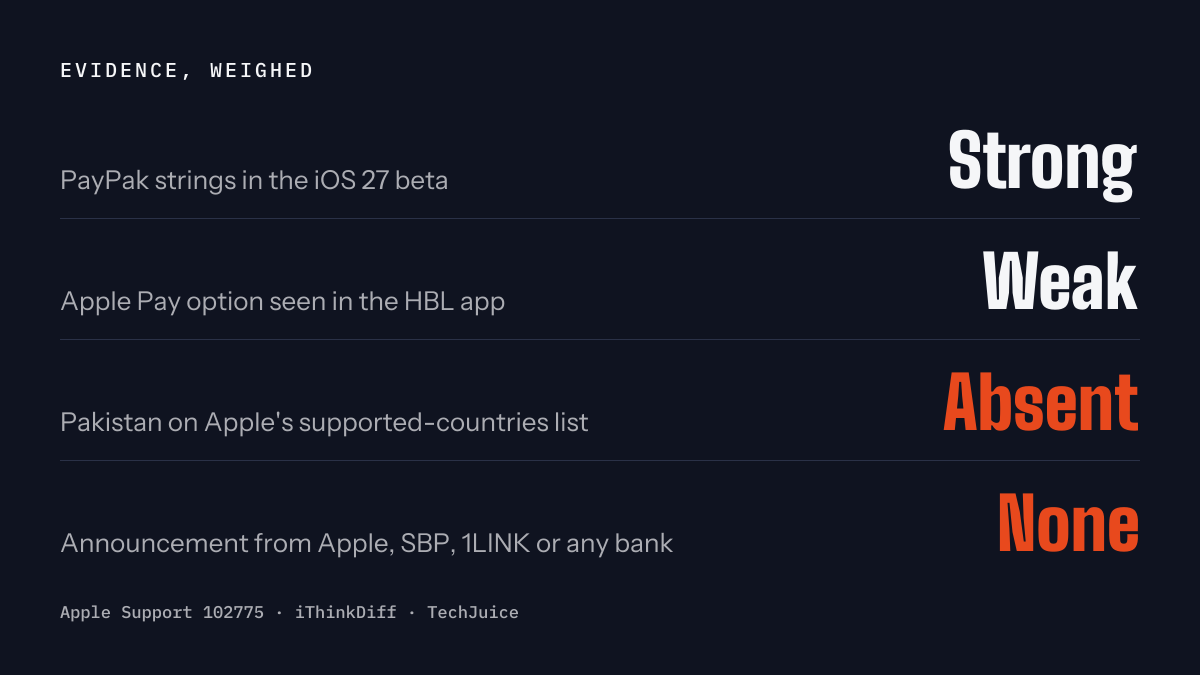
So the presence of a PayPak entry establishes one thing with reasonable confidence: someone inside Apple has done engineering work on Pakistan's domestic card scheme. That is meaningful. Apple does not localise strings for networks it has no intention of supporting.
What they do not establish
They do not establish a launch date. They do not establish that commercial terms have been agreed with Pakistani banks, that the State Bank of Pakistan has approved anything, or that 1LINK — which owns and operates PayPak — has a signed agreement.
Payment network integrations have been visible in Apple's code for a long time before launching, and some have sat there for years. Code is the cheapest part of shipping a payments product. The expensive parts are the contracts, the certification, and the regulator.
The strongest counter-evidence
Pakistan is not on Apple's own list of countries and regions that support Apple Pay. That list is maintained by Apple, updated on launch day, and is the only source that settles the question. Until Pakistan appears on it, Apple Pay is not available in Pakistan, regardless of what a beta contains.
Apple has made no announcement. Neither has the State Bank of Pakistan, nor 1LINK, nor any of the banks named in the reporting.
The bank-app sightings
Separately, users have posted screenshots of an Apple Pay option appearing inside the HBL app, and several outlets report that Standard Chartered, Bank Alfalah and UBL have been testing the functionality.
Treat these as weaker evidence than the code, not stronger. App builds are rolled out progressively, feature flags leak, and a toggle appearing in a build is not the same as a working transaction. Nobody has published a completed Apple Pay payment in Pakistan.
What would actually settle it
Three things, in rough order of how conclusive they are:
- Pakistan appearing on Apple's supported-countries page.
- An Apple newsroom post or a joint announcement with a Pakistani bank.
- A named person completing a real in-store transaction, with a receipt.
Everything short of that is inference. Reasonable inference — the code is genuinely suggestive, and the direction of travel across the whole Pakistani payments stack points the same way — but inference.
Why the distinction is worth insisting on
Because the gap between "being prepared" and "launched" is where most of the actual difficulty lives, and it is measured in interchange negotiations rather than weeks. India is the instructive case: Apple Pay was visibly in preparation there for years, and when it finally launched at the end of September 2026 it did so without UPI or RuPay support, after a protracted argument over basis points. We wrote about what that means for Pakistan separately.
If you are a founder building on the assumption that Apple Pay lands in Pakistan this quarter, the honest position is that you do not know that, and neither does anyone writing about it.
Sources
- Countries and regions that support Apple Pay — Apple Support
- iOS 27 Beta 5 Code Hints at Apple Pay Coming to Pakistan — iThinkDiff
- Apple Pay Coming to Pakistan: PayPak Found in iOS 27 Code — TechJuice
- PayPak — 1LINK
- Raast: Pakistan's Instant Payment System — State Bank of Pakistan
- Apple Pay finally launches in India after years on the sidelines — TechCrunch
Published by FounderDuels. Corrections: [email protected]
Something here wrong or out of date?
Tell usMore from the blog
All posts- The Pakistani fintech opportunity map, late 2026Where the gaps actually are: reconciliation, recurring billing, merchant credit, and the boring infrastructure nobody posts about. With the numbers behind each one.
- Apple Pay in Pakistan: what would have to be true for it to launch this yearWorking backwards from a launch to the specific conditions it requires — and an honest assessment of which of them we have evidence for.
- A founder's guide to Pakistani payment rails in 2026Raast, PayPak, Visa and Mastercard, JazzCash and Easypaisa, and possibly Apple Pay. What each one is actually good for, and what it costs you to support.