3 min read
PayPak explained: the domestic card scheme Apple would have to support
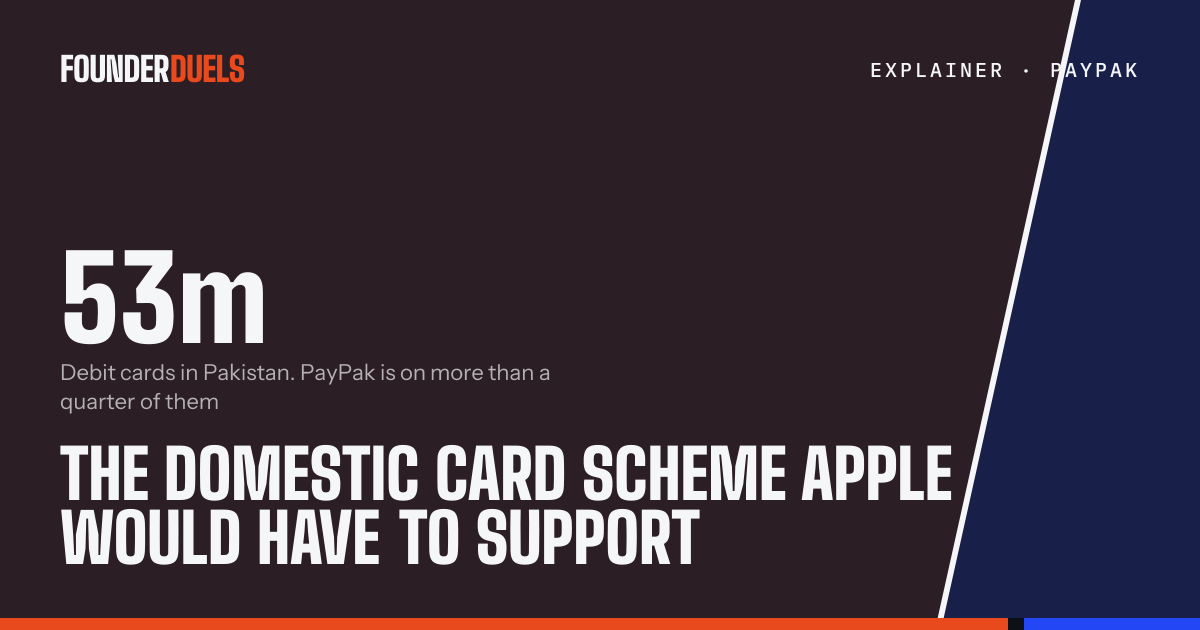
PayPak is on more than a quarter of Pakistan's 53 million debit cards and carries about 6% of card spending. Understanding that gap explains most of Pakistani payments.
By the FounderDuels team ·
Every country that has built a domestic card scheme built it for the same reason: to stop paying Visa and Mastercard a toll on domestic transactions, in foreign currency, forever. India has RuPay. Russia has Mir. Turkey has Troy. Brazil has Elo. Pakistan has PayPak.
PayPak is owned and operated by 1LINK, the interbank switch, under the aegis of the State Bank of Pakistan. It is the network whose name turned up in the iOS 27 beta, which is why anyone outside Pakistani banking is suddenly reading about it.
The numbers that matter
Two figures, and the distance between them is the whole story.
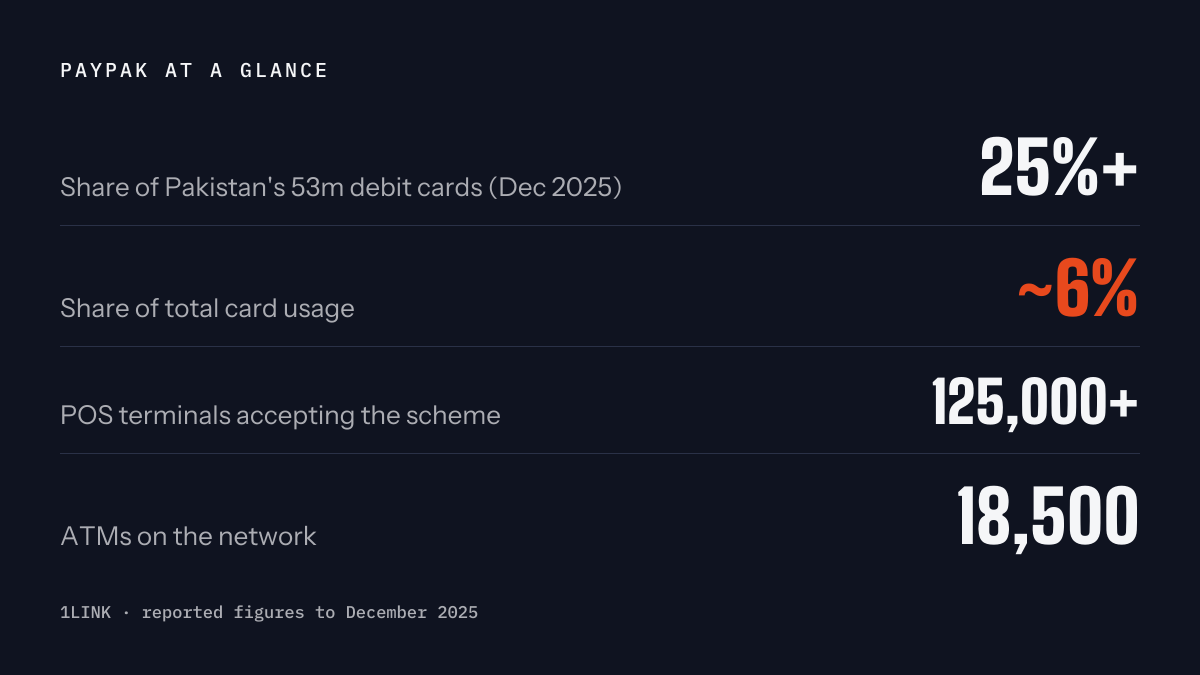
By December 2025, PayPak accounted for more than 25% of the 53 million debit cards issued in Pakistan. It also accounted for about 6% of total card usage.
A quarter of the cards. A sixteenth of the spending.
Why the gap exists
PayPak cards are cheap for banks to issue and cheap for customers to hold, which is exactly why there are so many of them. They get handed out with basic accounts, salary accounts and financial-inclusion products. Many of them live in a drawer.
The cards that get used — for e-commerce, for travel, for subscriptions, for anything priced in dollars — are Visa and Mastercard, because PayPak is a domestic scheme and does not work abroad or on most international sites. A PayPak card is, for a lot of holders, an ATM card with a chip on it.
So the scheme has scale in issuance and almost none in spend. That is not a failure of the scheme; it is a consequence of what it was issued for.
The acceptance side is real
Where PayPak is genuinely strong is acceptance infrastructure. The network runs across more than 125,000 point-of-sale terminals and 18,500 ATMs nationwide, and its EMV chip cards support both contact and NFC contactless transactions.
That last detail is the one worth holding on to, because it is the physical precondition for Apple Pay working anywhere. Tap-to-pay needs contactless terminals, and Pakistan already has them in the tens of thousands. Whatever else is missing, the hardware largely is not.
Where it is going
1LINK has been pushing PayPak up the value chain on two fronts.
First, credit. 1LINK's chief executive, Najeeb Agrawalla, has said the company is working with member banks and the regulator to launch a PayPak credit card later in 2026 — Pakistan's first domestic credit card, if it lands. A domestic scheme that only does debit is structurally capped; credit is where card economics actually live.
Second, mandate. In August 2026 1LINK proposed making PayPak cards compulsory for government salary accounts, subsidy disbursements, social safety-net programmes and mass-transit payments, explicitly to cut reliance on Visa and Mastercard.
That second proposal is the more consequential one, and it is genuinely double-edged. It would move enormous volume onto the domestic scheme overnight. It would also move it by fiat rather than by preference, which tends to produce a lot of cards and not much usage — which is the problem PayPak already has.
What this has to do with Apple Pay
If Apple supports PayPak at launch, Apple Pay becomes available to a quarter of Pakistani debit cardholders in one step, including many people who have never used a card for anything but cash withdrawal. That would be a genuinely significant financial-inclusion event.
If Apple launches on Visa and Mastercard only — which is what happened in India, where the domestic scheme was coded for and then absent on day one — then Apple Pay in Pakistan reaches the people who already had the most payment options, and PayPak's 6% problem stays exactly where it is.
The iOS 27 strings suggest Apple has done the work for the first outcome. India suggests you should not assume it.
Sources
- Countries and regions that support Apple Pay — Apple Support
- iOS 27 Beta 5 Code Hints at Apple Pay Coming to Pakistan — iThinkDiff
- Apple Pay Coming to Pakistan: PayPak Found in iOS 27 Code — TechJuice
- PayPak — 1LINK
- Raast: Pakistan's Instant Payment System — State Bank of Pakistan
- Apple Pay finally launches in India after years on the sidelines — TechCrunch
Published by FounderDuels. Corrections: [email protected]
Something here wrong or out of date?
Tell usMore from the blog
All posts- The Pakistani fintech opportunity map, late 2026Where the gaps actually are: reconciliation, recurring billing, merchant credit, and the boring infrastructure nobody posts about. With the numbers behind each one.
- Apple Pay in Pakistan: what would have to be true for it to launch this yearWorking backwards from a launch to the specific conditions it requires — and an honest assessment of which of them we have evidence for.
- A founder's guide to Pakistani payment rails in 2026Raast, PayPak, Visa and Mastercard, JazzCash and Easypaisa, and possibly Apple Pay. What each one is actually good for, and what it costs you to support.