3 min read
Raast by the numbers: the rail that changed Pakistani payments before Apple showed up
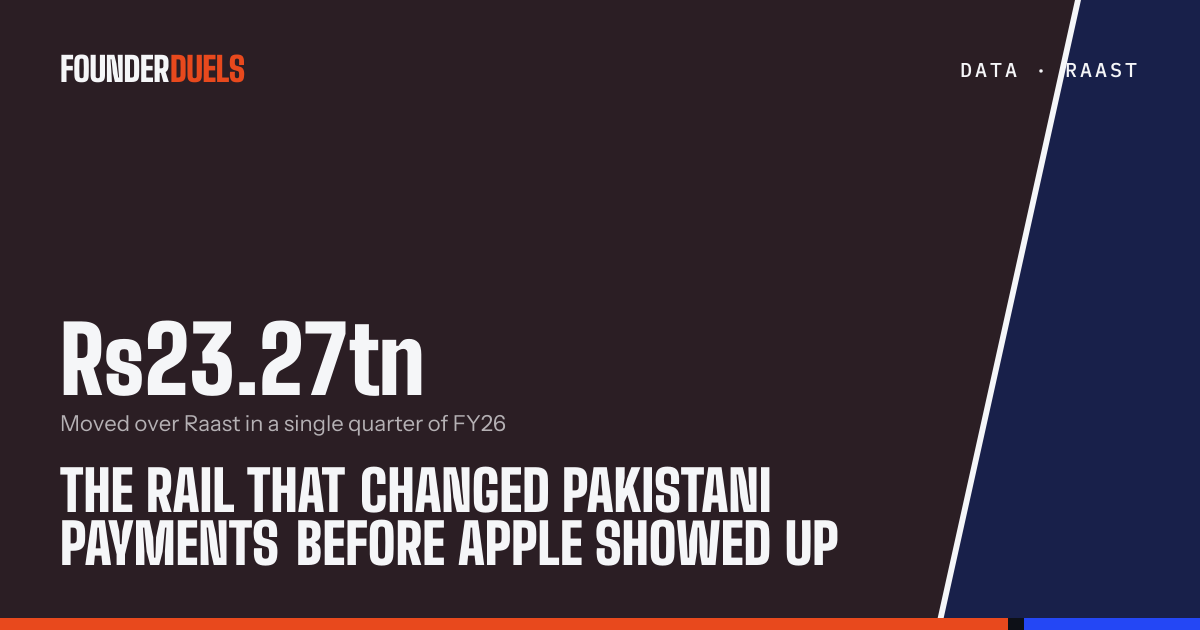
742 million transactions worth Rs23.27 trillion in one quarter, 2.6 million merchants onboarded, and a state subsidy behind the QR code. Raast is the context for everything else.
By the FounderDuels team ·
Most coverage of Apple Pay in Pakistan treats the country as a payments backwater waiting to be modernised from Cupertino. The data says something close to the opposite. Pakistan built a national instant-payment rail, put serious public money behind merchant adoption, and moved an enormous share of retail payments onto it — all before Apple wrote a line of PayPak code.
If you want to understand what Apple Pay would be walking into, start here.
The quarter in figures
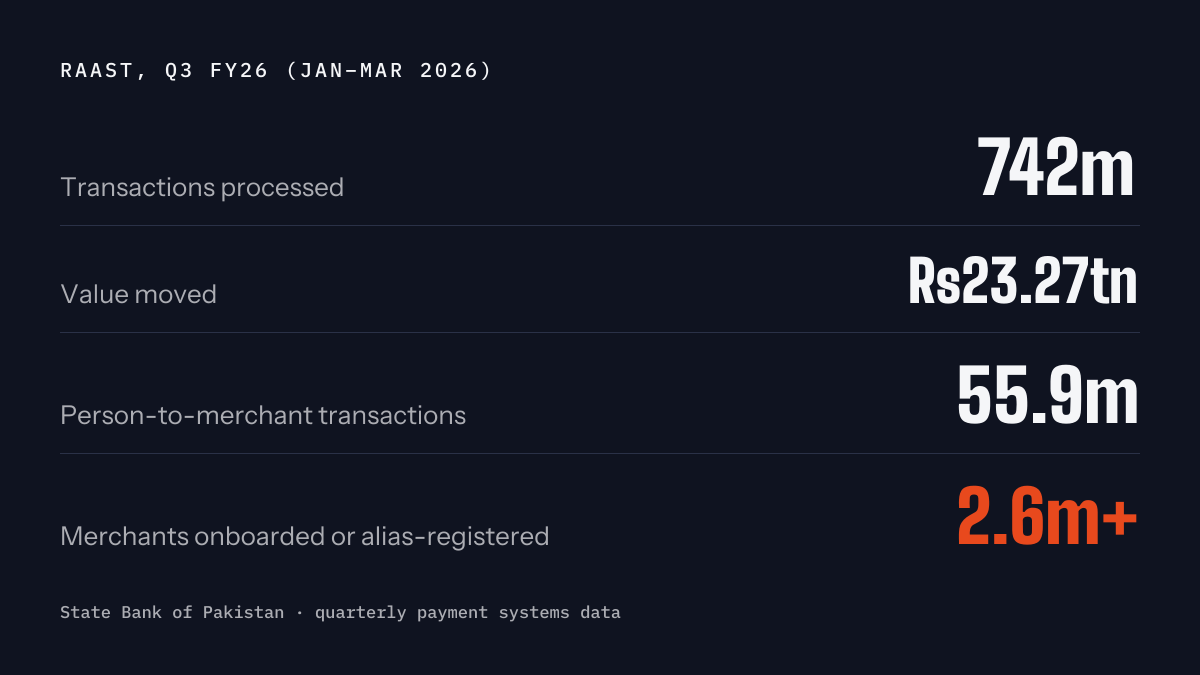
In the third quarter of FY26 — January to March 2026 — Raast processed 742 million transactions worth Rs23.27 trillion.
Broken down:
- Person-to-person: 664 million transactions, Rs18.9 trillion, up about 10% on the previous quarter.
- Person-to-merchant: 55.9 million transactions, up from 36.3 million the quarter before. That is roughly 54% growth in three months.
Across the whole banking system, retail payments in that quarter came to 3.7 billion transactions, of which 3.4 billion — 92% by volume — went through digital channels.
The merchant number is the important one
More than 2.6 million merchants had been onboarded to Raast P2M or registered their aliases by the end of March 2026.
Merchant acceptance is the hard half of any payments network. Consumers adopt a payment method in an afternoon; merchants adopt it when enough consumers already have it, which is the chicken-and-egg problem that kills most payment launches. Pakistan solved it with money: the State Bank allocated Rs3.5 billion to a Raast QR subsidy programme for FY2025-26.
It worked. Daily P2M transactions went from roughly 60,000 in June 2025 to about 1.1 million by June 2026. That is not incremental growth. That is a step change, bought deliberately.
Why this matters for Apple Pay
Three implications, and none of them are comfortable for a card product.
The behaviour is already digital. The story "Pakistanis will finally stop using cash when Apple Pay arrives" is not true. 92% of retail payment volume was already digital in early 2026. What Apple Pay changes is which digital instrument, not whether.
The incumbent is free and subsidised. A Raast QR payment costs the merchant approximately nothing and has had public money pushing it. A card payment carries interchange, and Apple Pay adds a slice on top of that. Apple Pay is arriving on the expensive rail in a market being actively steered towards the cheap one.
Apple Pay does not run on Raast. This is the point most commentary misses. Apple Pay is a card-credential product: it tokenises a card and presents it over NFC. Raast is an account-to-account instant transfer, mostly initiated by QR. They are different animals. Apple supporting PayPak — a card scheme — says nothing about Raast.
For Apple Pay to work on Raast would require something like what India is still waiting for with UPI: a separate regulatory approval, a sponsor arrangement, and a technical model for a rail that was not designed around card tokens. In India, Apple Pay launched without UPI. There is no reason to expect Pakistan to be easier.
The honest summary
Apple Pay in Pakistan, if and when it lands, will be a premium convenience layer on top of a card market that carries a minority of digital payments, in a country whose actual payments revolution already happened on a different rail with the central bank's money behind it.
That is still worth having. It is just a much narrower claim than "Apple Pay will transform Pakistani payments", which is what most of the current coverage implies.
Sources
- Electronic payments reach 3.7b transactions — The Express Tribune
- Raast: Pakistan's Instant Payment System — State Bank of Pakistan
- PayPak — 1LINK
- 1LINK proposes mandatory PayPak cards for govt salaries — Profit by Pakistan Today
- EBANX advances emerging market infrastructure with Pakistan expansion in motion — GlobeNewswire
- Countries and regions that support Apple Pay — Apple Support
Published by FounderDuels. Corrections: [email protected]
Something here wrong or out of date?
Tell usMore from the blog
All posts- The Pakistani fintech opportunity map, late 2026Where the gaps actually are: reconciliation, recurring billing, merchant credit, and the boring infrastructure nobody posts about. With the numbers behind each one.
- Apple Pay in Pakistan: what would have to be true for it to launch this yearWorking backwards from a launch to the specific conditions it requires — and an honest assessment of which of them we have evidence for.
- A founder's guide to Pakistani payment rails in 2026Raast, PayPak, Visa and Mastercard, JazzCash and Easypaisa, and possibly Apple Pay. What each one is actually good for, and what it costs you to support.