3 min read
PayPak's 6% problem: a quarter of the cards, a sixteenth of the spending
Pakistan's domestic card scheme has scale in issuance and almost none in usage. That single gap explains 1LINK's mandate proposal, the credit-card plan, and why Apple support matters.
By the FounderDuels team ·
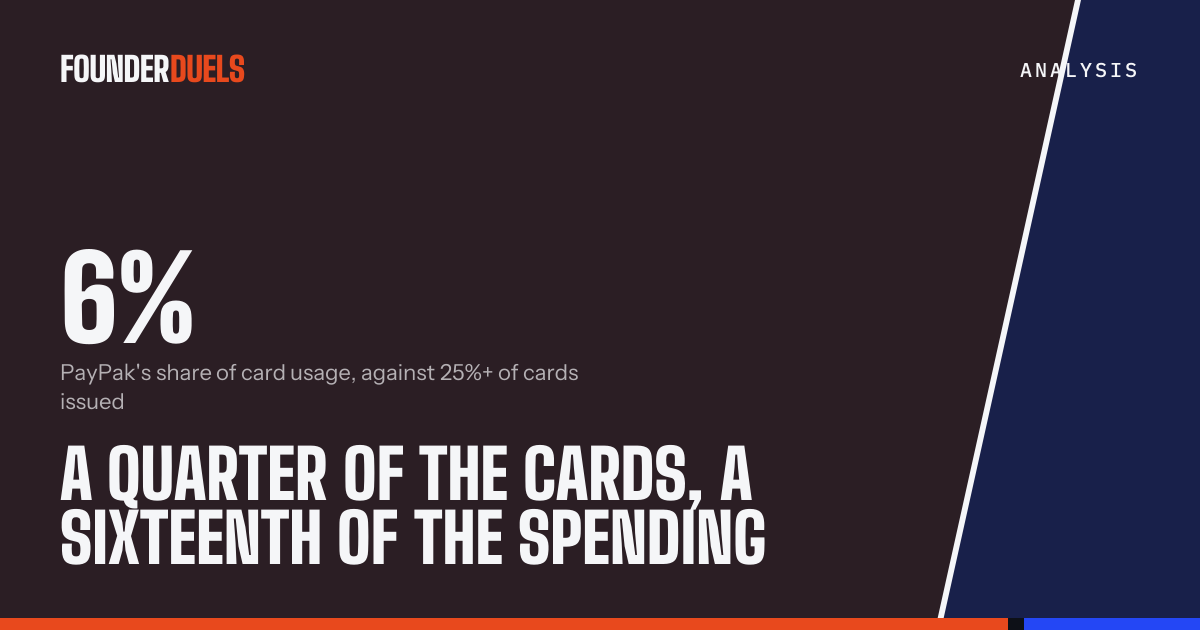
Here are the two numbers that define Pakistan's domestic card scheme, as of December 2025.
PayPak was on more than 25% of the country's 53 million debit cards. It carried about 6% of total card usage.
Every strategic move 1LINK has made in 2026 is an attempt to close that gap.
Where the gap comes from
A PayPak card is cheap to issue. It carries no international scheme fee, so banks put it on the products where margin is thinnest: basic accounts, salary accounts, financial-inclusion products, and anything opened to meet a branchless-banking target.
That produces cards. It does not produce spending, for a straightforward reason: the card cannot be used outside Pakistan, and it does not work on most international websites. So the customer who has both a PayPak card and a Visa debit card uses the Visa one for anything that is not an ATM withdrawal — and a great many PayPak holders have no second card at all, and use theirs exactly as they used the ATM card it replaced.
A scheme in that position has a distribution problem disguised as an adoption problem.
The two fixes on the table
Credit. 1LINK's chief executive, Najeeb Agrawalla, has said the company is working with member banks and the regulator towards a PayPak credit card later in 2026 — which would be Pakistan's first domestic credit card. This is the structurally serious fix. Debit interchange is thin everywhere; credit is where card economics actually work, and a scheme locked out of credit is locked out of the profitable half of its own industry.
Mandate. In August 2026, 1LINK proposed making PayPak cards compulsory for government salary accounts, subsidy disbursements, social safety-net programmes and mass-transit payments, explicitly framed as cutting reliance on Visa and Mastercard.
Why the mandate is the riskier idea
It would work, in the narrow sense. Route government salaries and Benazir-style disbursements through PayPak and the card count rises sharply and instantly.
But issuance is not the problem. Issuance is already at a quarter of the market. The problem is that issued PayPak cards do not get used for purchases, and a mandate that produces more cards in more drawers makes the headline number better and the underlying ratio worse.
There is also a real consumer-choice question in compelling the recipients of social safety-net payments — the people with the least leverage in the system — onto a specific card product. That is worth saying plainly, even if the industrial logic behind it is sound.
What Apple support would actually do
This is why the iOS 27 PayPak strings are a bigger deal for 1LINK than for Apple.
If a PayPak card can be added to Apple Wallet, the card stops being a piece of plastic for ATM visits and becomes a tap-to-pay instrument sitting on the device people already hold in their hand at the till. That is precisely the usage problem PayPak has, addressed at precisely the right point.
It would apply to a minority of Pakistani cardholders — the iPhone-owning segment is small and affluent — but it is the segment with the highest transaction frequency, and it would give banks a reason to issue PayPak to customers they currently give Visa.
Which is a genuinely good outcome for a domestic scheme, and a reason to watch whether PayPak is actually supported at launch, or merely coded for. India's experience with RuPay — present in the code, absent on day one — is the case for not assuming.
The measure to watch
Not cards issued. Not merchants signed. Share of card usage. If PayPak's 6% starts moving, something real has changed. If card issuance climbs while the usage share stays flat, then whatever has happened, it is not adoption.
Sources
- Electronic payments reach 3.7b transactions — The Express Tribune
- Raast: Pakistan's Instant Payment System — State Bank of Pakistan
- PayPak — 1LINK
- 1LINK proposes mandatory PayPak cards for govt salaries — Profit by Pakistan Today
- EBANX advances emerging market infrastructure with Pakistan expansion in motion — GlobeNewswire
- Countries and regions that support Apple Pay — Apple Support
Published by FounderDuels. Corrections: [email protected]
Something here wrong or out of date?
Tell usMore from the blog
All posts- The Pakistani fintech opportunity map, late 2026Where the gaps actually are: reconciliation, recurring billing, merchant credit, and the boring infrastructure nobody posts about. With the numbers behind each one.
- Apple Pay in Pakistan: what would have to be true for it to launch this yearWorking backwards from a launch to the specific conditions it requires — and an honest assessment of which of them we have evidence for.
- A founder's guide to Pakistani payment rails in 2026Raast, PayPak, Visa and Mastercard, JazzCash and Easypaisa, and possibly Apple Pay. What each one is actually good for, and what it costs you to support.