3 min read
Is Pakistan NFC-ready? What 125,000 terminals tell you
Tap-to-pay needs contactless terminals, and Pakistan already has them in the tens of thousands. The hardware is the part that is not missing.
By the FounderDuels team ·
Every discussion of Apple Pay arriving somewhere eventually hits the practical question: will it actually work at the shop? Tap-to-pay is not magic. It needs a contactless-capable terminal on the merchant's counter, running software that speaks EMV contactless, connected to an acquirer that can route the transaction.
On this specific question, Pakistan is in better shape than the discourse suggests.
The installed base
PayPak runs across more than 125,000 point-of-sale terminals and 18,500 ATMs nationwide. The scheme's EMV chip cards support both contact and contactless (NFC) transactions.
That last clause is the one that matters. Contactless acceptance is not something Pakistani merchants would need to buy in anticipation of Apple Pay. It is already deployed, because the domestic scheme specified it and the international schemes have been pushing contactless for years.
An Apple Pay transaction presents a tokenised card credential over NFC. To the terminal, it looks like a contactless card tap. A terminal that accepts a contactless card accepts a phone.
Where the real gaps are
Three, and none of them are the terminal.
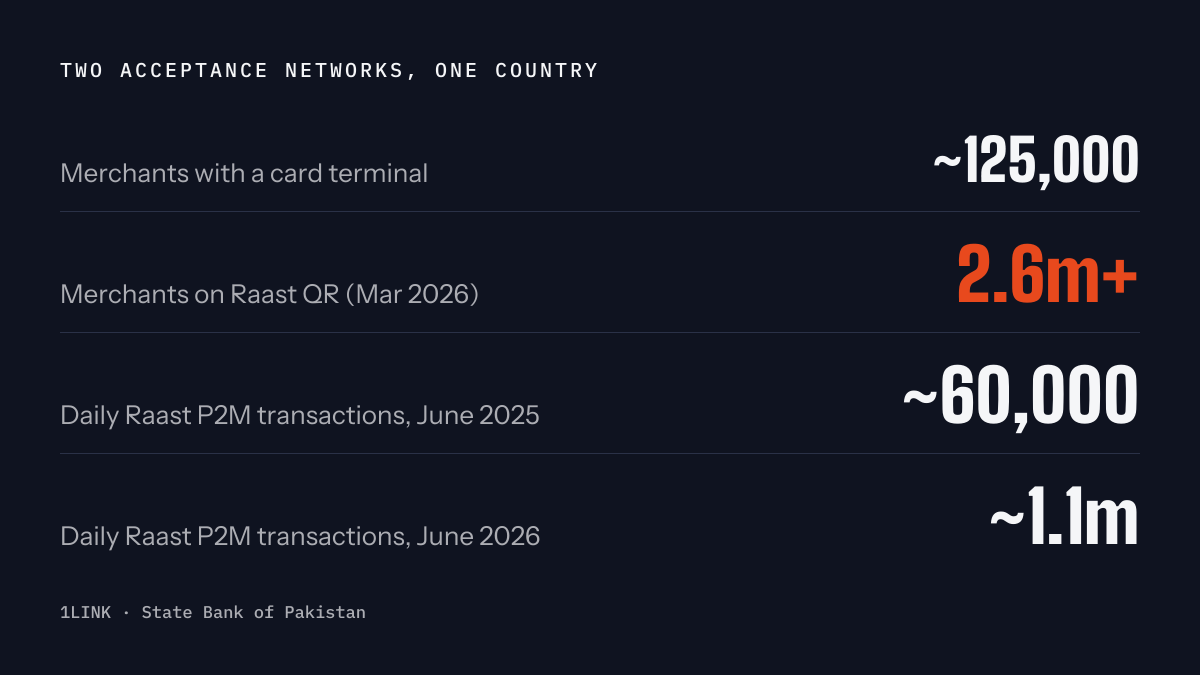
Distribution, not capability. 125,000 terminals across a country of Pakistan's size is thin. They cluster in urban retail, organised chains, hotels, fuel and pharmacy. A large share of Pakistani commerce happens at merchants who have never had a card terminal and never will, because the economics of a terminal do not work at their transaction sizes. Those merchants took a QR code instead — which is exactly what the Raast P2M push did, reaching 2.6 million merchants by March 2026, an order of magnitude more than have terminals.
So the honest picture is two parallel acceptance networks: a card network in the tens of thousands, and a QR network in the millions. Apple Pay plugs into the small one.
Issuer-side tokenisation. The terminal is ready; the bank may not be. Provisioning a card into Apple Wallet requires the issuer to support tokenisation, run the verification step, and manage the token lifecycle. That is real engineering work per bank, and it is the likeliest explanation for the reported testing at HBL, Standard Chartered, Bank Alfalah and UBL.
Contactless transaction limits. Most markets cap contactless-without-PIN at a modest amount. Apple Pay normally clears higher limits because the device authenticates the user biometrically, but whether a given market's rules allow that is a regulator-and-scheme decision, not an Apple one. If Pakistan launches with a low no-PIN ceiling, the experience is markedly worse, and this is a detail worth asking about that nobody is currently asking.
What a founder should take from this
If you are building anything that depends on in-person card acceptance in Pakistan, the constraint is not NFC hardware. It is that the card acceptance network is small, urban and organised-retail-shaped, while the payment behaviour of most of the country now runs over QR on a rail that does not charge interchange.
Apple Pay does not change that. It makes the existing card network nicer to use for people who already use it.
Sources
- Electronic payments reach 3.7b transactions — The Express Tribune
- Raast: Pakistan's Instant Payment System — State Bank of Pakistan
- PayPak — 1LINK
- 1LINK proposes mandatory PayPak cards for govt salaries — Profit by Pakistan Today
- EBANX advances emerging market infrastructure with Pakistan expansion in motion — GlobeNewswire
- Countries and regions that support Apple Pay — Apple Support
Published by FounderDuels. Corrections: [email protected]
Something here wrong or out of date?
Tell usMore from the blog
All posts- The Pakistani fintech opportunity map, late 2026Where the gaps actually are: reconciliation, recurring billing, merchant credit, and the boring infrastructure nobody posts about. With the numbers behind each one.
- Apple Pay in Pakistan: what would have to be true for it to launch this yearWorking backwards from a launch to the specific conditions it requires — and an honest assessment of which of them we have evidence for.
- A founder's guide to Pakistani payment rails in 2026Raast, PayPak, Visa and Mastercard, JazzCash and Easypaisa, and possibly Apple Pay. What each one is actually good for, and what it costs you to support.