3 min read
Apple Pay just launched in India. Here is what that tells Pakistan
Apple Pay went live in India at the end of September 2026 — with one bank, no UPI and no RuPay, after a fight over basis points. Pakistan's launch will look similar.
By the FounderDuels team ·
At the end of September 2026, after years of speculation that looked a great deal like the speculation now running in Pakistan, Apple Pay launched in India. It is the single most useful precedent available for anyone trying to guess what a Pakistani launch looks like, because the two markets share the shape of the problem: a huge population, thin card spend, a dominant domestic instant-payment rail, and a domestic card scheme the government would like people to use.
The Indian launch is worth studying closely, because it went live in a much smaller form than the hype had promised.
It launched with one bank
Reporting around the launch had Apple Pay going live with Axis Bank cards. HDFC Bank, ICICI Bank and SBI Card — between them a very large share of Indian card spend — were not part of the launch, with commercial negotiations still open.
The lesson for Pakistan: "Apple Pay launches in Pakistan" will not mean "your card works". It will mean some cards from some banks work, and whether yours is among them depends on what your bank agreed to.
It launched without the rail everyone actually uses
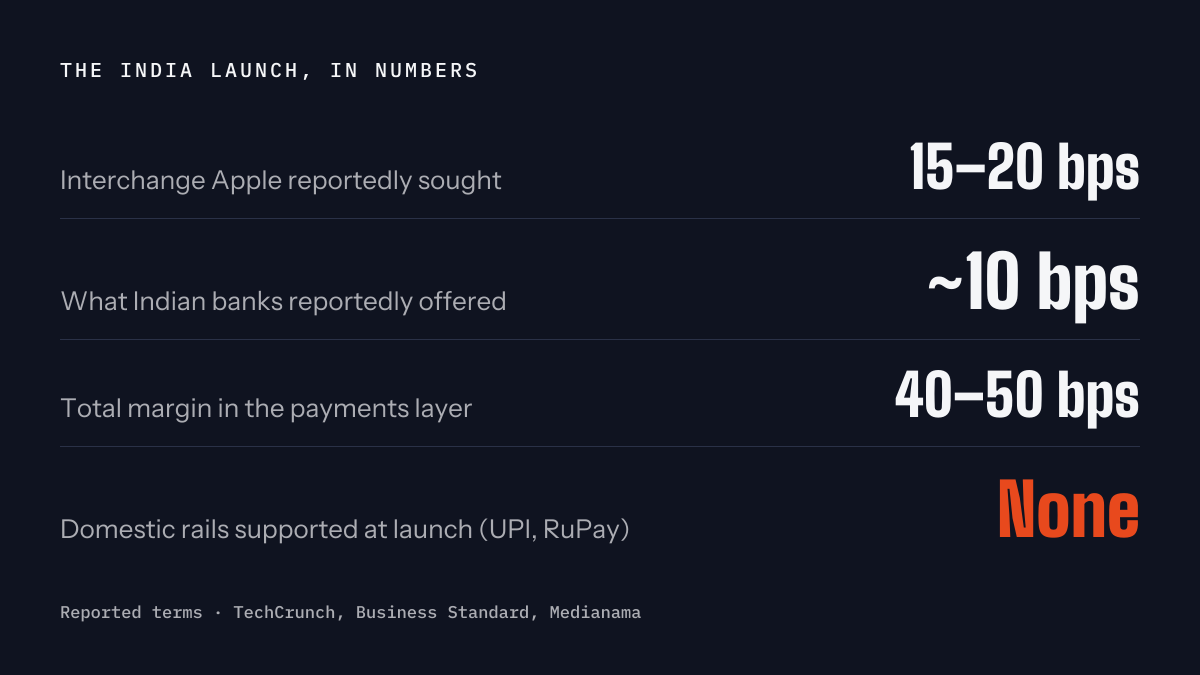
UPI, which carries the overwhelming majority of Indian retail digital payments, was not supported at launch. Neither was RuPay, the domestic card scheme. Adding UPI requires a separate approval from NPCI and a sponsor bank to route transactions, and Apple had secured neither.
This is the part Pakistani coverage keeps skipping. The PayPak strings in iOS 27 are being read as proof that Apple Pay will work with PayPak cards from day one. India's launch is a direct example of a domestic scheme being coded for, talked about, and then absent when the product actually shipped.
Raast — Pakistan's instant-payment rail, and the thing that has actually changed Pakistani payment behaviour — is a still more distant prospect. Apple Pay is a card product. Raast is not cards.
The fight was over basis points
The reported sticking point in India was interchange: Apple asking for roughly 15–20 basis points of each transaction, banks countering at around 10. For context, the entire payments layer runs on something like 40–50 basis points of margin. Apple was asking for a third to a half of it.
That fee does not come from the customer or the merchant. It comes out of the issuing bank's existing interchange revenue. Which is why banks fight it, and why launches slip by years rather than weeks.
Pakistani interchange economics are thinner than India's, not fatter. If Apple asks for comparable terms here, Pakistani banks have less room to give.
What this predicts for Pakistan
Not a date — nobody has one. But a shape:
- A partial launch. One or two banks first, more later, cards only.
- International schemes before domestic ones. Visa and Mastercard credit and debit cards are the likeliest day-one support. PayPak, despite the code, may well follow rather than lead.
- No Raast. Not at launch, plausibly not for a long time.
- A quiet gap between "coming" and "here." India's took years of visible preparation.
The uncomfortable implication
If Apple Pay in Pakistan launches as a card product on international schemes, it lands on the narrowest part of the Pakistani payments market — the part that was already digital, already urban, already banked. The 3.4 billion digital retail transactions Pakistan processed in a single quarter of 2026 overwhelmingly did not happen on a card.
That is not an argument that Apple Pay does not matter here. It is an argument that it will matter to a specific and fairly small group first, and that founders building around it should be clear-eyed about who that group is.
Sources
- Countries and regions that support Apple Pay — Apple Support
- iOS 27 Beta 5 Code Hints at Apple Pay Coming to Pakistan — iThinkDiff
- Apple Pay Coming to Pakistan: PayPak Found in iOS 27 Code — TechJuice
- PayPak — 1LINK
- Raast: Pakistan's Instant Payment System — State Bank of Pakistan
- Apple Pay finally launches in India after years on the sidelines — TechCrunch
Published by FounderDuels. Corrections: [email protected]
Something here wrong or out of date?
Tell usMore from the blog
All posts- The Pakistani fintech opportunity map, late 2026Where the gaps actually are: reconciliation, recurring billing, merchant credit, and the boring infrastructure nobody posts about. With the numbers behind each one.
- Apple Pay in Pakistan: what would have to be true for it to launch this yearWorking backwards from a launch to the specific conditions it requires — and an honest assessment of which of them we have evidence for.
- A founder's guide to Pakistani payment rails in 2026Raast, PayPak, Visa and Mastercard, JazzCash and Easypaisa, and possibly Apple Pay. What each one is actually good for, and what it costs you to support.